

How Siam stayed independent in the age of empire
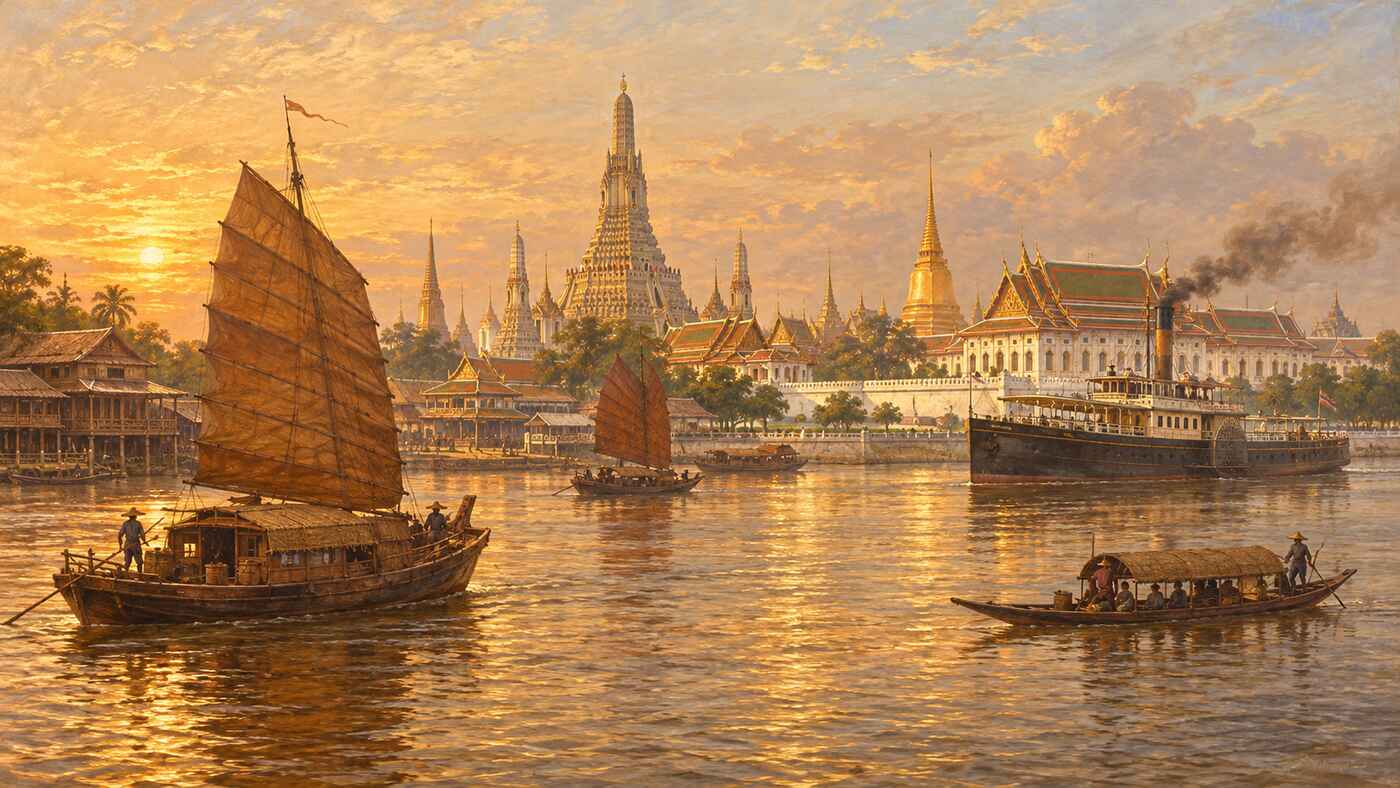
Published 19 November 2026.
In short: Siam, today’s Thailand, was the only kingdom in Southeast Asia that was never ruled by a European power. It survived by opening to trade on unequal terms in 1855, modernising its state under Kings Mongkut and Chulalongkorn, giving up outlying territory to France and Britain between 1893 and 1909, and serving as a buffer between British Burma and Malaya and French Indochina, as an Anglo-French agreement of 1896 confirmed.
By 1900 almost all of Southeast Asia was under European rule. Britain held Burma and the Malay states, France had built Indochina from Vietnam, Cambodia and Laos, and the Dutch ruled the East Indies. Siam alone remained independent. How it did so is one of the most debated questions in the history of the region. The answer combines diplomacy, reform, geography and painful concessions.
Opening to the West: the Bowring Treaty of 1855
The first step came under King Mongkut (Rama IV), who had watched China’s defeat in the First Opium War. Rather than resist, he negotiated. The Bowring Treaty with Britain, signed on 18 April 1855, opened Siam to free trade. According to Britannica, it limited import duties to 3% and gave British subjects extraterritorial rights, meaning they were tried in British consular courts rather than Siamese ones. Similar treaties with other Western powers followed.
The terms were unequal and cost Siam control over its tariffs and part of its legal sovereignty. But they also gave the Western powers a commercial stake in a stable, independent Siam, and removed a common pretext for invasion.
Reform under Chulalongkorn
Mongkut’s son, King Chulalongkorn (Rama V), reigned from 1868 to 1910 and carried reform much further. He reorganised the government into ministries, centralised the administration of the provinces, abolished slavery and corvée labour in stages, built railways and telegraphs, and created a modern army and schools. Historians writing in a Springer volume on Siamese diplomacy describe how both kings used what would now be called soft power: they learned Western languages, employed foreign advisers from several countries rather than one, and presented Siam as a “civilised” state that did not need a colonial ruler.
Chulalongkorn also travelled. A study published by Thailand’s Ministry of Foreign Affairs describes his European tour of 1897, when he met heads of state in person and won recognition as a fellow monarch.
The Paknam crisis of 1893
The gravest threat came from France, which was expanding west from Vietnam into the lands of Laos that Siam claimed. In July 1893 French gunboats forced their way up the Chao Phraya river past the Paknam forts to Bangkok. Under the settlement that followed, described in the same Foreign Ministry study, Siam gave up its claims to territory east of the Mekong, paid an indemnity of three million francs, and accepted French occupation of Chanthaburi as a guarantee.
A buffer state: the 1896 agreement
The crisis worried Britain, which did not want a French border next to British Burma. In January 1896 Britain and France agreed to guarantee the independence of the central Chao Phraya basin, the heart of Siam. The Thai Foreign Ministry study describes this as the agreement that turned Siam into a buffer between the two empires. It did not protect Siam’s outer provinces, but it made the conquest of its core much less likely.
Trading territory for sovereignty, 1904–1909
In the following years Siam negotiated away further outlying lands in exchange for recovering control over its own affairs. Treaties with France in 1904 and 1907 ceded territory west of the Mekong and in western Cambodia, including Battambang and Siem Reap with the Angkor temples, and France withdrew from Chanthaburi. The Anglo-Siamese Treaty of 1909, signed on 10 March 1909, transferred Siam’s rights over the Malay states of Kedah, Kelantan, Terengganu and Perlis to Britain. In return, as a Foreign Ministry history of the negotiations records, Britain gave up most extraterritorial rights over its subjects in Siam and lent Siam £4 million for a southern railway.
Siam regained full control over its tariffs and legal system only in the 1920s and 1930s, as the unequal treaties were renegotiated.
Independent, or “semi-colonial”?
Siam kept its monarchy, its government and its core territory. Britannica and most general histories describe Thailand as the only Southeast Asian country never colonised. Some historians, however, argue that it was “semi-colonial”: it lost large areas, gave up tariff and legal control for decades, and reformed partly on Western terms. The Springer chapter discusses this debate. Both views agree on the outcome that mattered most to Siam’s rulers at the time: no European flag flew over Bangkok.
Key takeaways
- Siam was the only Southeast Asian kingdom never ruled by a European power.
- The 1855 Bowring Treaty opened it to trade on unequal terms but gave the West a stake in its stability.
- Kings Mongkut and Chulalongkorn modernised the state and used diplomacy skilfully.
- Siam gave up outlying territory to France (1893–1907) and Britain (1909).
- The 1896 Anglo-French agreement confirmed its role as a buffer state.
Common questions
Was Thailand ever colonised?
No. Siam, as it was then called, kept its own monarchy and government throughout the colonial era, though it lost outlying territories and accepted unequal treaties.
What was the Bowring Treaty?
A treaty with Britain signed in 1855 that opened Siam to free trade, capped import duties at 3% and gave British subjects extraterritorial rights.
What happened in the Paknam crisis?
In 1893 French gunboats forced their way to Bangkok. Siam gave up its claims east of the Mekong, paid three million francs and accepted French occupation of Chanthaburi.
Why did Britain and France leave Siam independent?
Neither wanted the other on its border. An 1896 agreement guaranteed Siam’s central basin as a buffer between British Burma and Malaya and French Indochina.
How this essay was made: events and dates were checked on 19 November 2026 against Britannica, two histories published by Thailand’s Ministry of Foreign Affairs, a Springer scholarly chapter and the text of the 1909 treaty.
Sources
- Britannica: Bowring Treaty
- Britannica: History of Thailand
- Thai Ministry of Foreign Affairs: The Grand Tour That Saved a Nation (PDF)
- Thai Ministry of Foreign Affairs: The Anglo-Siamese Negotiations, 1900–1909 (PDF)
- Springer: chapter on Siamese diplomacy under Mongkut and Chulalongkorn
- Wikipedia: Anglo-Siamese Treaty of 1909
