

Great Moravia: the first great Slavic state in Central Europe
Updated 19 November 2026.
In short: Great Moravia was a Slavic state that grew up along the Morava river in the 9th century, covering parts of today’s Czech Republic and Slovakia and, at its height, wider lands. Under Rostislav (846–870) it invited the Byzantine missionaries Cyril and Methodius, who arrived in 863. Under Svatopluk (870–894) it reached its greatest extent. It collapsed in the early 10th century, after the arrival of the Magyars.
Great Moravia lasted less than a century, yet it holds a large place in the history of Central Europe. It was the first major state of the western Slavs, a meeting point between the Frankish and Byzantine worlds, and the home of the first Slavic written language used in church. For Czechs and Slovaks it remains a reference point in national history. This essay sets out what historians generally agree on, and where the evidence is thin.
Origins on the Morava
The state takes its name from the Morava river. According to Britannica, Slavs settled the region by the 6th century, and by the early 9th century a Moravian principality had formed under rulers of the Mojmír dynasty. Britannica’s account of Czechoslovak history records that Prince Mojmír I attached the principality of Nitra, in what is now western Slovakia, to his realm in about 833, expelling its ruler Pribina.
The name “Great Moravia” itself comes later. It is used by the 10th-century Byzantine emperor Constantine VII Porphyrogenitus in his work on governing the empire, and modern historians adopted it. Contemporary Frankish sources simply speak of Moravians.
Rostislav and the mission of Cyril and Methodius
Mojmír was succeeded by his nephew Rostislav, who ruled from 846 to 870. Rostislav’s main problem was the powerful East Frankish kingdom to the west, whose clergy were already active in Moravia. To strengthen his position, he asked the Byzantine emperor for teachers who could instruct his people in their own language.
The answer was the mission of two brothers from Thessaloniki, Constantine (later known as Cyril) and Methodius. Britannica dates their arrival to 863. They brought a new alphabet, the Glagolitic script, created to write the Slavic speech they knew, and translated liturgical texts into what is now called Old Church Slavonic. Their work, later approved in Rome, made the Slavic language a language of worship alongside Latin and Greek, a rare achievement at the time.
Constantine died in Rome in 869. Methodius returned as archbishop, but faced hostility from Frankish bishops and was imprisoned for a time. He died in 884, after which his disciples were expelled from Moravia. Many of them continued their work in Bulgaria, where the Cyrillic alphabet later developed.
Svatopluk and the height of power
Rostislav was overthrown in 870 by his nephew Svatopluk, who handed him to the Franks. Svatopluk then ruled until 894. Under him, Britannica says, Great Moravia extended its power over Bohemia, parts of southern Poland and lands in present-day Hungary. It was the high point of the state.
Svatopluk’s reign was also marked by constant conflict and shifting alliances with the East Frankish rulers. In 892 King Arnulf of East Francia campaigned against Moravia, and Frankish sources report that he sought help from the Magyars, then arriving on the edge of the Carpathian Basin.
Collapse in the early 10th century
After Svatopluk’s death in 894 the state was weakened by disputes between his sons, Mojmír II and Svatopluk II, and by the loss of Bohemia, which broke away in 895. The Magyars settled the Carpathian Basin in the 890s. Britannica dates the destruction of Great Moravia by the Magyars to about 906, although the exact date and the process are uncertain because written sources fall silent.
What archaeology shows
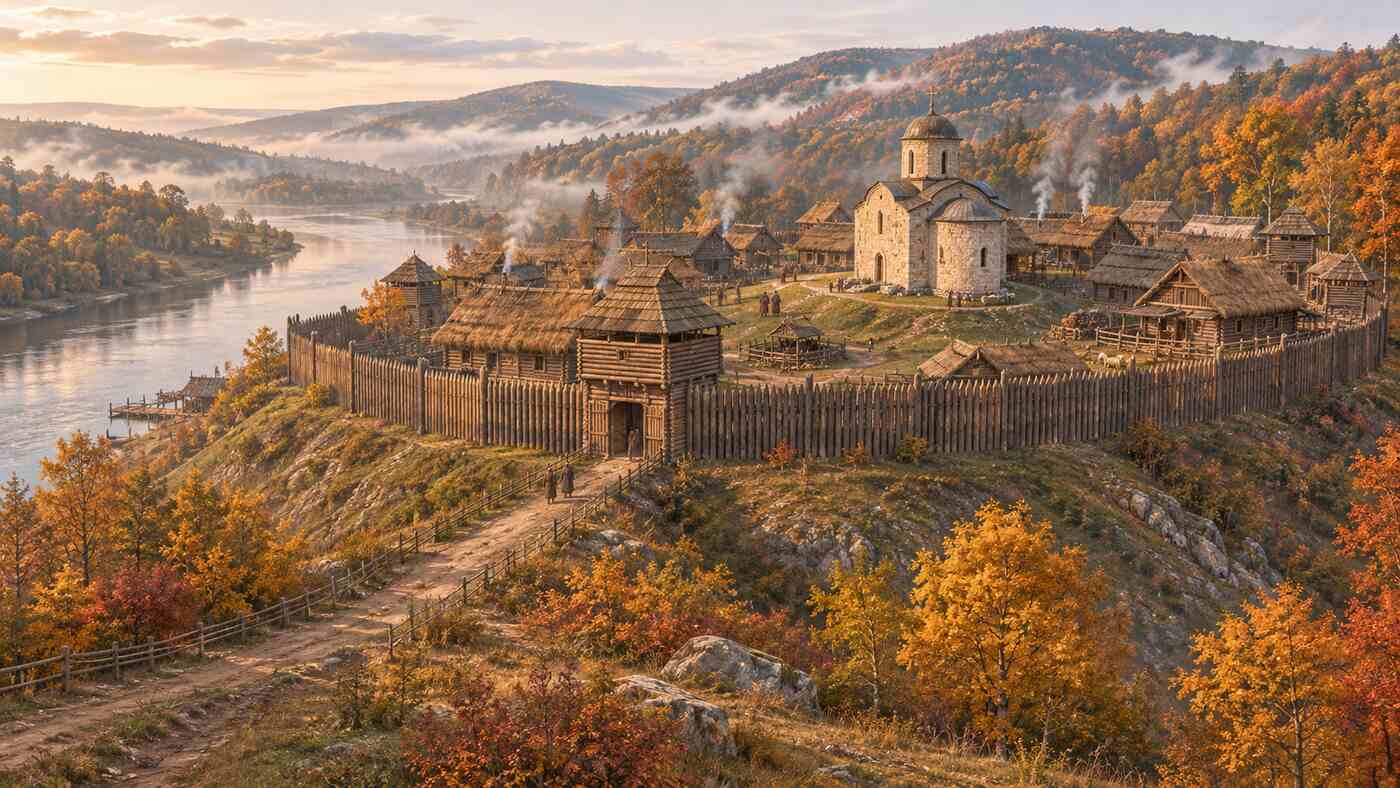
Much of what is known comes from excavation rather than texts. Fortified centres such as Mikulčice and Staré Město in Moravia, and sites in western Slovakia including Nitra, Devín and Bratislava, have revealed the foundations of stone churches, rich graves with jewellery and weapons, and evidence of craft production. These finds show a wealthy, Christianised elite and a society connected to both western and Byzantine trade. Mikulčice alone has produced the remains of a dozen churches.
Why Great Moravia still matters
- Language and writing. The work of Cyril and Methodius laid foundations for Slavic literacy across Central, Eastern and South-Eastern Europe.
- Religion. Christianity became firmly established among the western Slavs in this period.
- National memory. Both Czech and Slovak national movements of the 19th century looked back to Great Moravia as an early common state. The feast of Saints Cyril and Methodius on 5 July is a public holiday in both countries today.
Key takeaways
- Great Moravia emerged on the Morava river in the 9th century under the Mojmír dynasty.
- Rostislav invited Cyril and Methodius, who arrived in 863 and created a Slavic church language and script.
- Svatopluk (870–894) took the state to its greatest extent.
- It fell apart in the early 10th century, after the Magyars arrived; Britannica gives about 906.
Common questions
Where was Great Moravia?
Its core lay along the Morava river, in today’s eastern Czech Republic and western Slovakia. At its height under Svatopluk it also controlled Bohemia and other neighbouring lands.
Who were Cyril and Methodius?
Two Byzantine brothers from Thessaloniki who arrived in Moravia in 863. They created the Glagolitic alphabet and translated church texts into Old Church Slavonic.
When did Great Moravia end?
It collapsed in the early 10th century after the Magyar arrival; Britannica dates its destruction to about 906.
Was Great Moravia a Czech or a Slovak state?
Neither in the modern sense. It was an early Slavic state whose territory included lands that are now part of both countries, and both look back to it.
How this essay was made: dates and events were checked against Britannica’s entries on Moravia, Czechoslovak history and Saints Cyril and Methodius on 19 November 2026. Where sources differ or are uncertain, the text says so.
